THE ORIGINS — 2004
CONNECTING THE EVIDENCE 2004–2008
A CONCEPTUAL BREAKTHROUGH — 2008
FORMAL INVESTIGATION — 2010
THE FORMATION OF NASMS — 2013
THE TURNING POINT — 2014
THE EMERGENCE OF RESTORATION SCIENCE
NASMS TODAY
WHAT NASMS IS TODAY
The earliest discussions challenged us to look beyond sleep as simply a period of rest. They opened a larger inquiry into whether sleep provides biological conditions necessary for processes that cannot be understood by studying wakefulness alone.
The answers were not contained within a single field. Progress required bringing clinical observations into conversation with neuroscience, biochemistry, physiology, molecular biology, and the developing science of sleep.
Examining dramatically different expressions of biological decline and exceptional longevity provided a new way to think about preservation. Rather than focusing on isolated pathways, attention increasingly turned toward the coordination of restorative processes across the organism.
The development of research infrastructure created an opportunity to examine these ideas more systematically. Physiological observation could now be integrated with the theoretical framework that had developed during the preceding years.
NASMS provided an institutional structure through which the developing body of work could be organized, discussed, investigated, and shared. Sleep remained central, while the questions surrounding it were becoming increasingly interdisciplinary.
The end of the original funded research period changed the scale of the work, but not its direction. The years that followed became a period of continued study, integration, and refinement of the ideas that had emerged from the original collaboration.
Over time, the investigation moved beyond asking what happens during sleep toward a more fundamental question: How does life preserve itself? This shift created the foundation for Restoration Science—a framework for examining restoration across levels of biological organization and across traditional disciplinary boundaries.
Today, NASMS carries this scientific journey forward through research, education, publication, and interdisciplinary collaboration. Its purpose is not simply to revisit the questions that began the journey, but to create a scientific community capable of investigating where those questions now lead.
The North American Sleep Medicine Society (NASMS) is a Texas nonprofit scientific and educational organization dedicated to advancing the understanding of human restoration. Our purpose is to investigate, integrate, teach, and translate knowledge concerning the biological processes that allow the human organism to preserve, repair, regulate, and restore itself.
NASMS was built on the conviction that human restoration cannot be fully understood from within the boundaries of any single discipline. We bring together knowledge from medicine, neuroscience, sleep science, physiology, biochemistry, molecular biology, physics, environmental science, and other relevant fields, seeking connections that may be overlooked when these disciplines are studied independently.
Our community is intentionally multidisciplinary. NASMS welcomes professionals throughout the healthcare continuum—from health coaches, nurses, therapists, and complementary and alternative medicine practitioners to physicians, scientists, biologists, researchers, and other healthcare professionals. Different levels of training bring different perspectives, but all can contribute to a deeper understanding of the conditions that support human restoration.
.
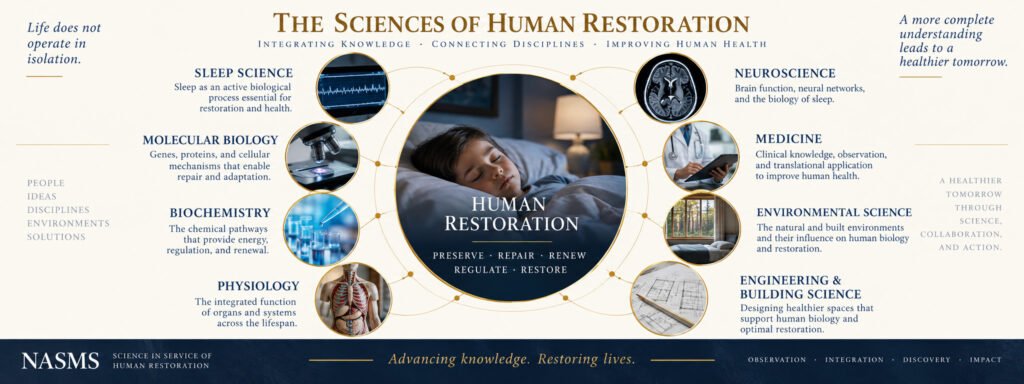
Our scope also extends beyond traditional healthcare. The environments in which people live—and particularly the environments in which they sleep—are part of the conditions under which restoration occurs. For this reason, NASMS also seeks collaboration with architects, engineers, builders, environmental professionals, building-science specialists, and others whose work influences human environmental exposure.
NASMS exists to research, educate, train, publish, convene, and build interdisciplinary collaboration. Rather than limiting inquiry to what is already established within individual disciplines, we seek to examine the available evidence across scientific boundaries, identify meaningful relationships, formulate better questions, and develop a more integrated understanding of human restoration.
Science in Service of Human Restoration
About NASMS
Mission & Vision
Governance
Leadership
Bylaws & Constitution
Education
Events
Membership
Support NASMS
PO Box 23007
Leander, TX. 78641
Email: info@nasms.org