RESTORATION SCIENCE

Restoration Science is an integrative scientific framework dedicated to understanding how living organisms preserve, repair, renew, regulate, adapt, and sustain biological integrity throughout life.

THE SCIENCE OF HOW LIFE PRESERVES ITSELF

Rather than examining restoration through a single organ, system, or discipline, Restoration Science studies the coordinated biological processes through which living systems maintain function, respond to disturbance, repair damage, and restore biological organization.

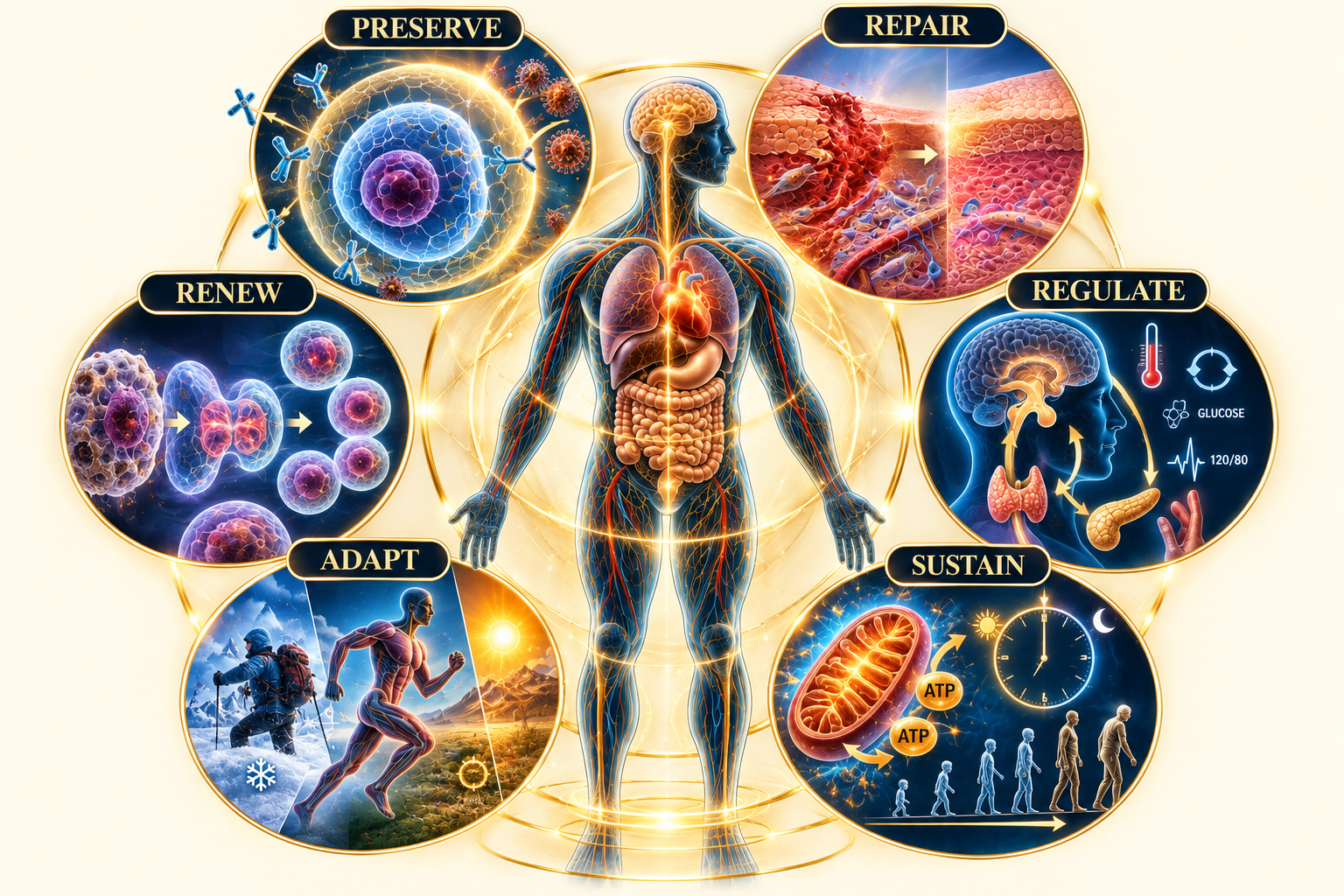
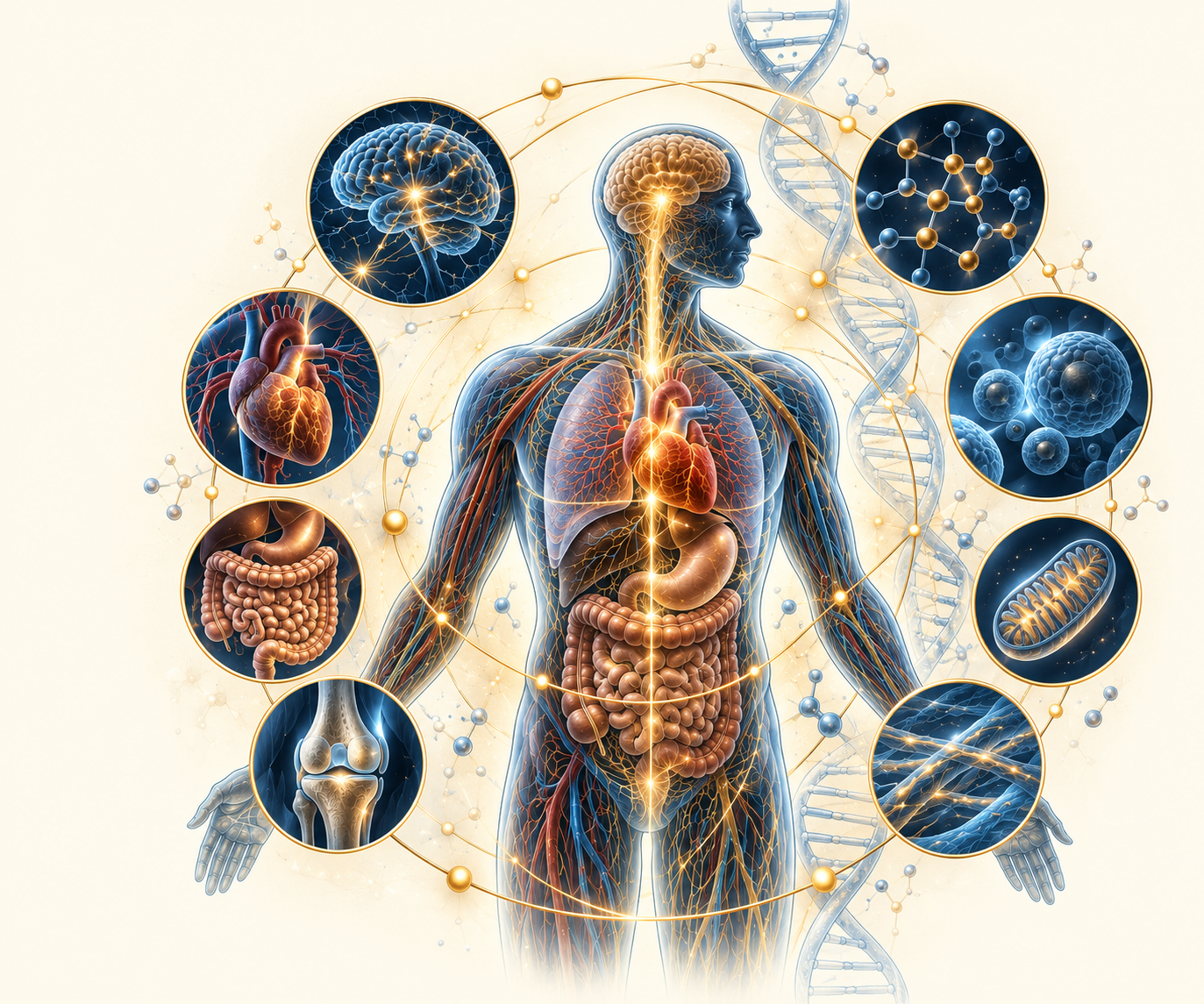
Restoration Science framework illustrating interconnected biological systems, including the brain, nervous system, cardiovascular system, digestive system, cells, mitochondria, DNA, and molecular processes involved in biological restoration.
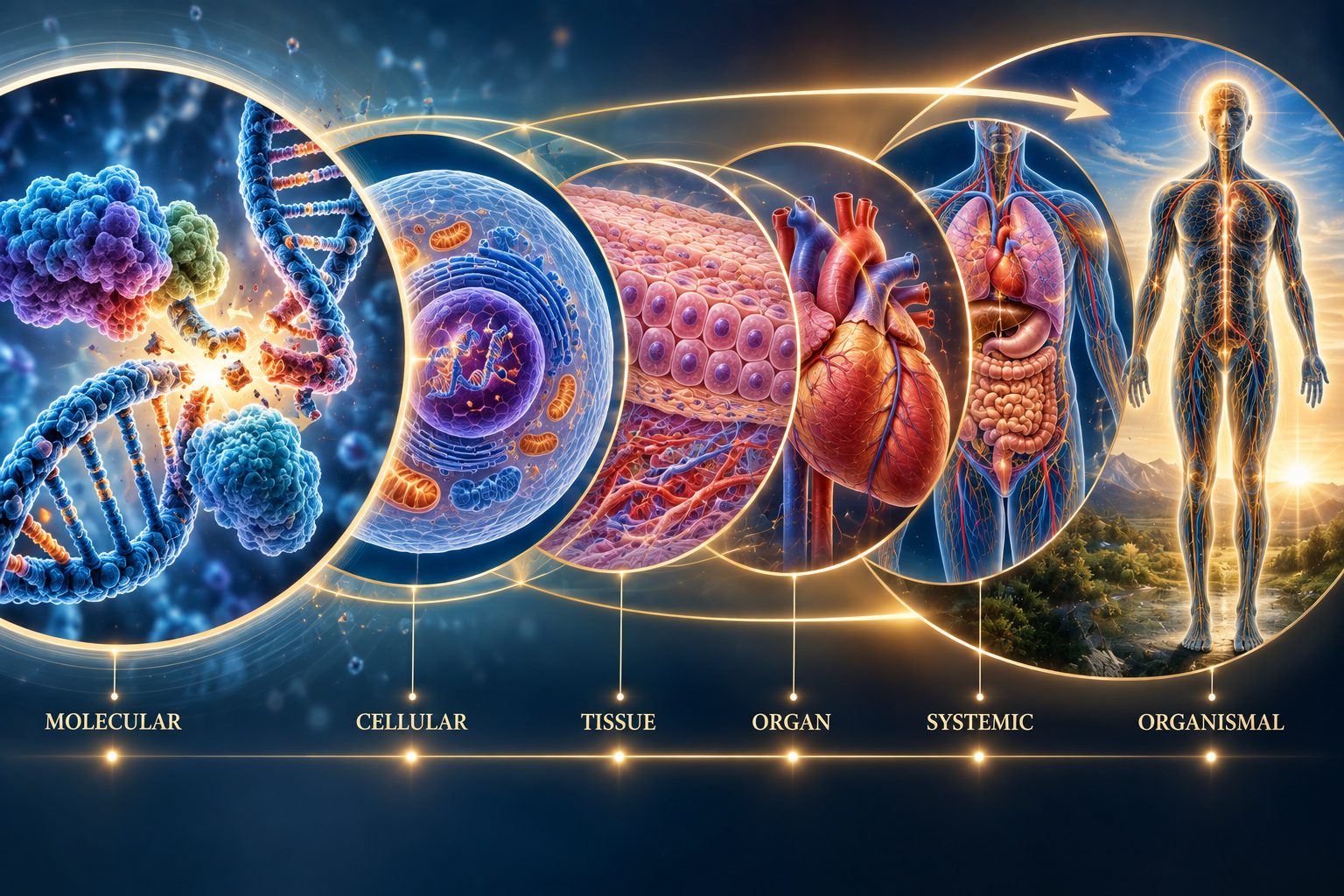
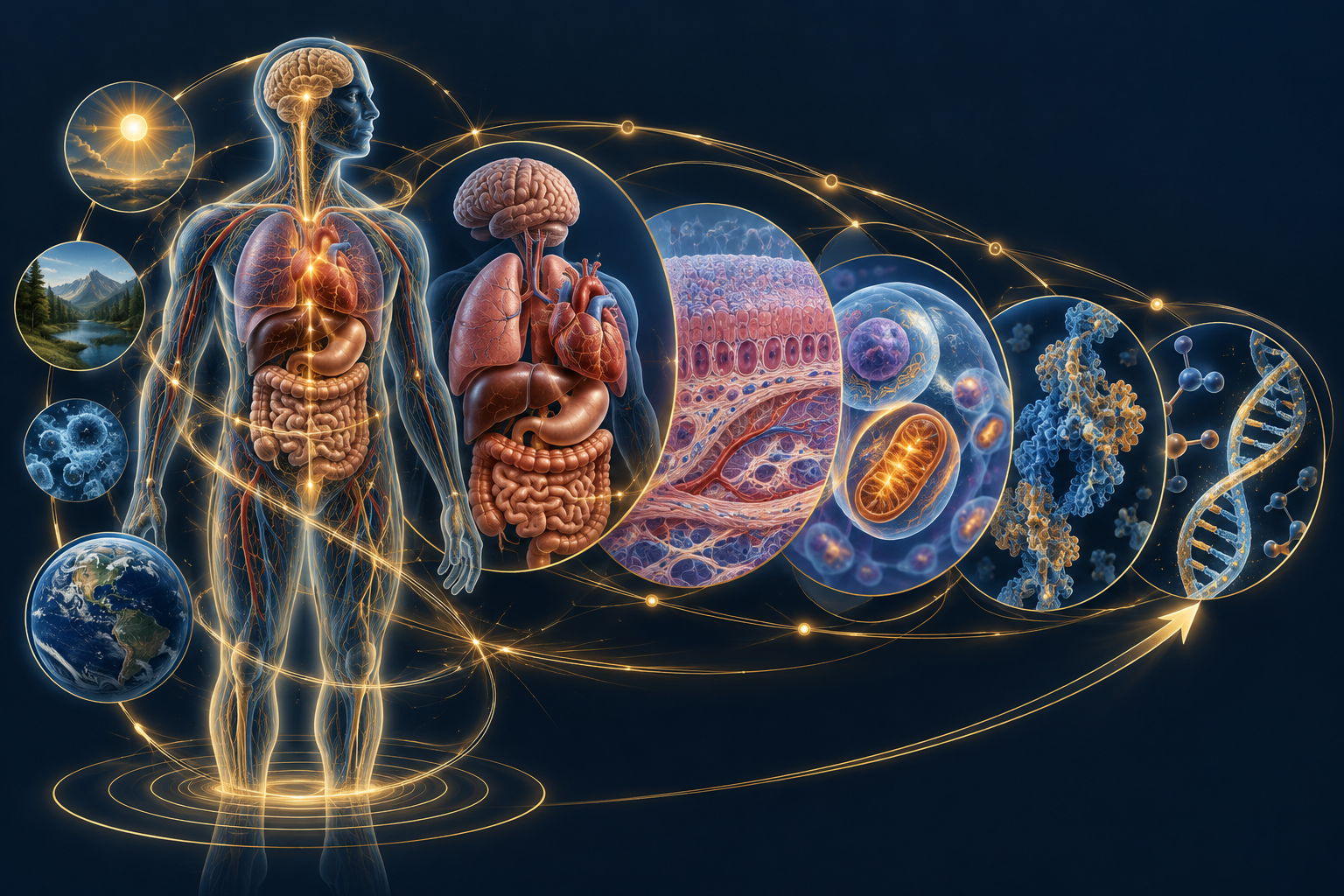
Human biological systems interacting with natural environmental factors across molecular, cellular, tissue, organ, and organismal levels.

THE CENTRAL QUESTION

HOW DOES A LIVING SYSTEM PRESERVE ITSELF?

Living systems are continuously exposed to internal and external change. Yet biological organization is not simply maintained—it is actively preserved, repaired, renewed, regulated, and adapted over time.

Restoration Science examines these processes as parts of a coordinated biological architecture rather than as isolated functions of individual organs or disciplines.

THE FUNCTIONS OF RESTORATION

RESTORATION IS NOT A SINGLE PROCESS

Living systems preserve themselves through multiple coordinated functions operating across biological levels. These functions respond to different biological needs, yet together contribute to the maintenance of organization, function, and integrity over time.

PRESERVE · REPAIR · RENEW · REGULATE · ADAPT · SUSTAIN

Each describes a different aspect of biological restoration—from maintaining existing structure and correcting damage to replacing components, maintaining stability, responding to changing conditions, and supporting function across time.

Restoration Science framework illustrating six coordinated biological processes: preserve, repair, renew, regulate, adapt, and sustain.
Restoration Science illustration showing biological restoration across molecular, cellular, tissue, organ, systemic, and organismal levels.

RESTORATION ACROSS BIOLOGICAL LEVELS

FROM MOLECULES TO THE WHOLE ORGANISM

Restoration does not occur at a single level of biology. It emerges through coordinated processes operating from molecules and cells to tissues, organs, physiological systems, and the organism as a whole.

Changes at one level can influence organization and function at another. Restoration Science therefore examines these biological levels not as isolated structures, but as interconnected scales of a living system.

MOLECULAR · CELLULAR · TISSUE · ORGAN · SYSTEMIC · ORGANISMAL

THE ENVIRONMENT AS A BIOLOGICAL VARIABLE

RESTORATION DOES NOT OCCUR IN ISOLATION

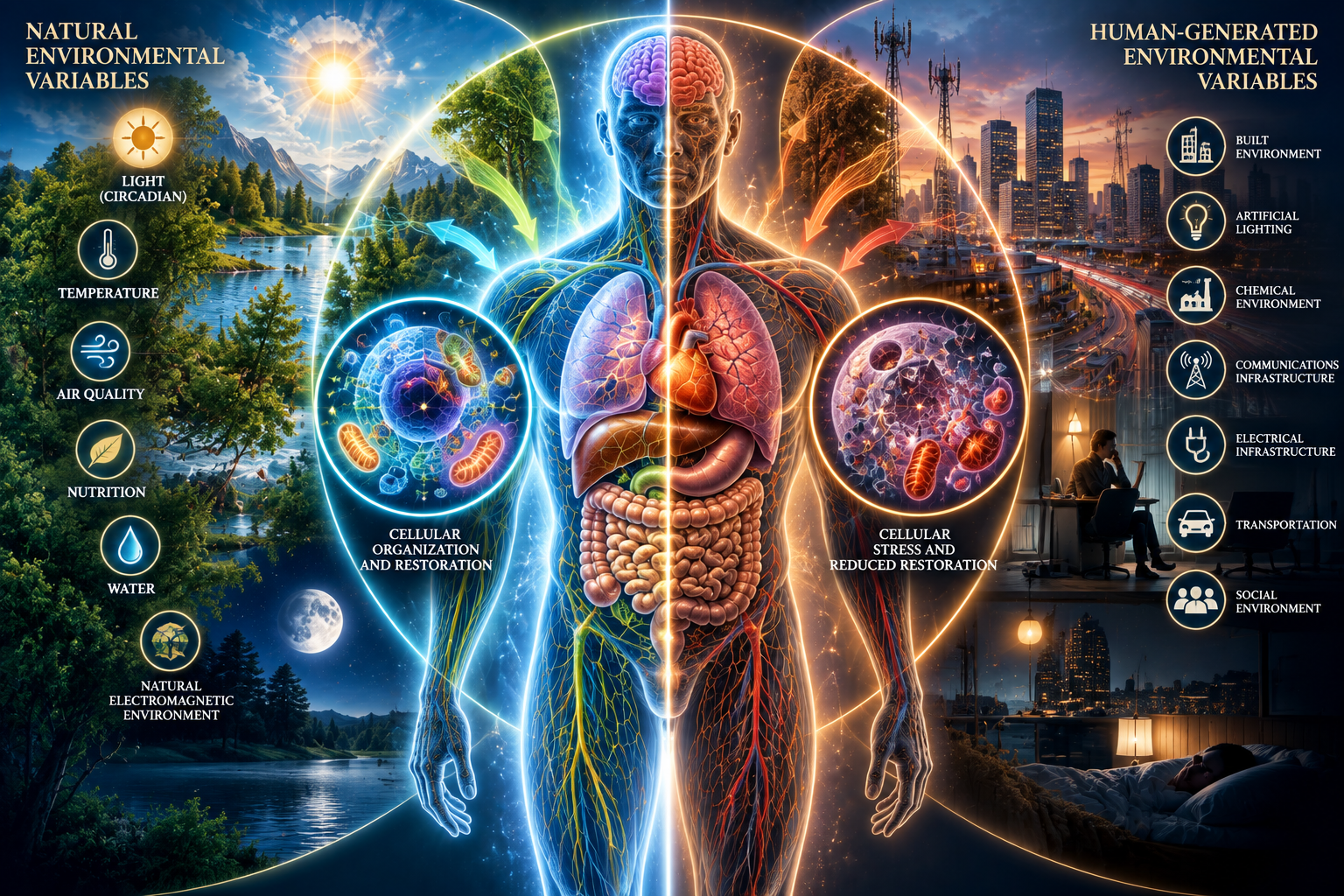
Living organisms exist in continuous interaction with their surroundings. Light, temperature, nutrition, chemical conditions, physical forces, social environments, and natural or human-generated environmental factors may become variables within the conditions under which biological restoration occurs.

Restoration Science examines these interactions while maintaining an essential scientific distinction: environmental exposure does not by itself establish biological effect, and biological effect does not by itself establish clinical consequence.

ENVIRONMENT → PHYSICAL INTERACTION → BIOLOGICAL RESPONSE → POSSIBLE CONSEQUENCE
Restoration Science illustration showing how natural and human-generated environmental variables may influence biological conditions and restorative processes.
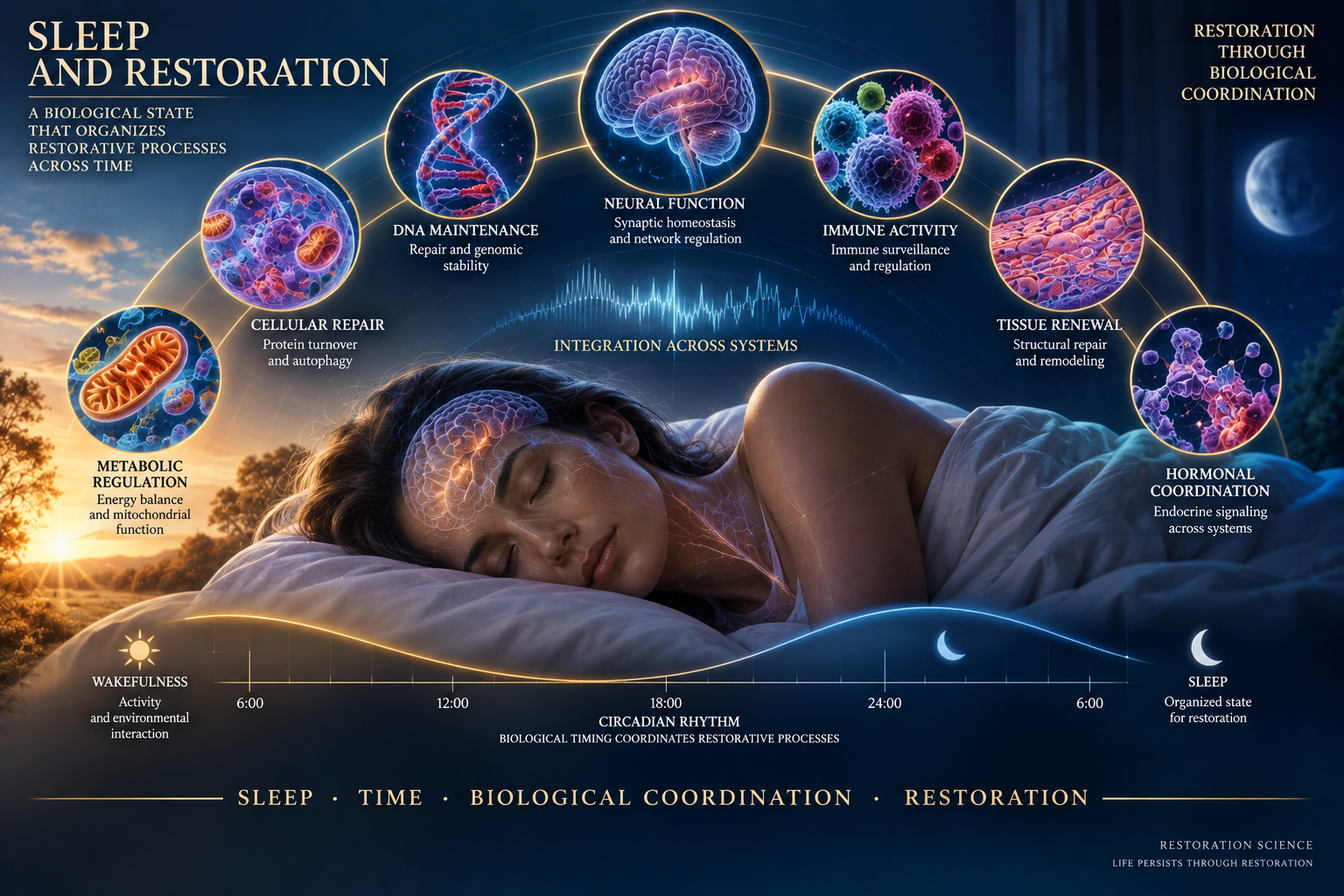
Restoration Science illustration showing sleep as a coordinated biological state involving neural function, DNA maintenance, cellular repair, immune activity, tissue renewal, metabolic regulation, and hormonal coordination.

SLEEP AND RESTORATION

SLEEP IS NOT RESTORATION — IT IS A BIOLOGICAL STATE IN WHICH RESTORATION IS ORGANIZED

Restoration occurs throughout life and is not confined to sleep. Sleep, however, provides a highly organized physiological state in which numerous processes associated with repair, renewal, regulation, metabolic coordination, and neural function are   organized.

Rather than viewing sleep simply as a period of inactivity, Restoration Science examines it as part of the biological architecture through which living systems coordinate restorative processes across time.

SLEEP · TIME · BIOLOGICAL COORDINATION · RESTORATION

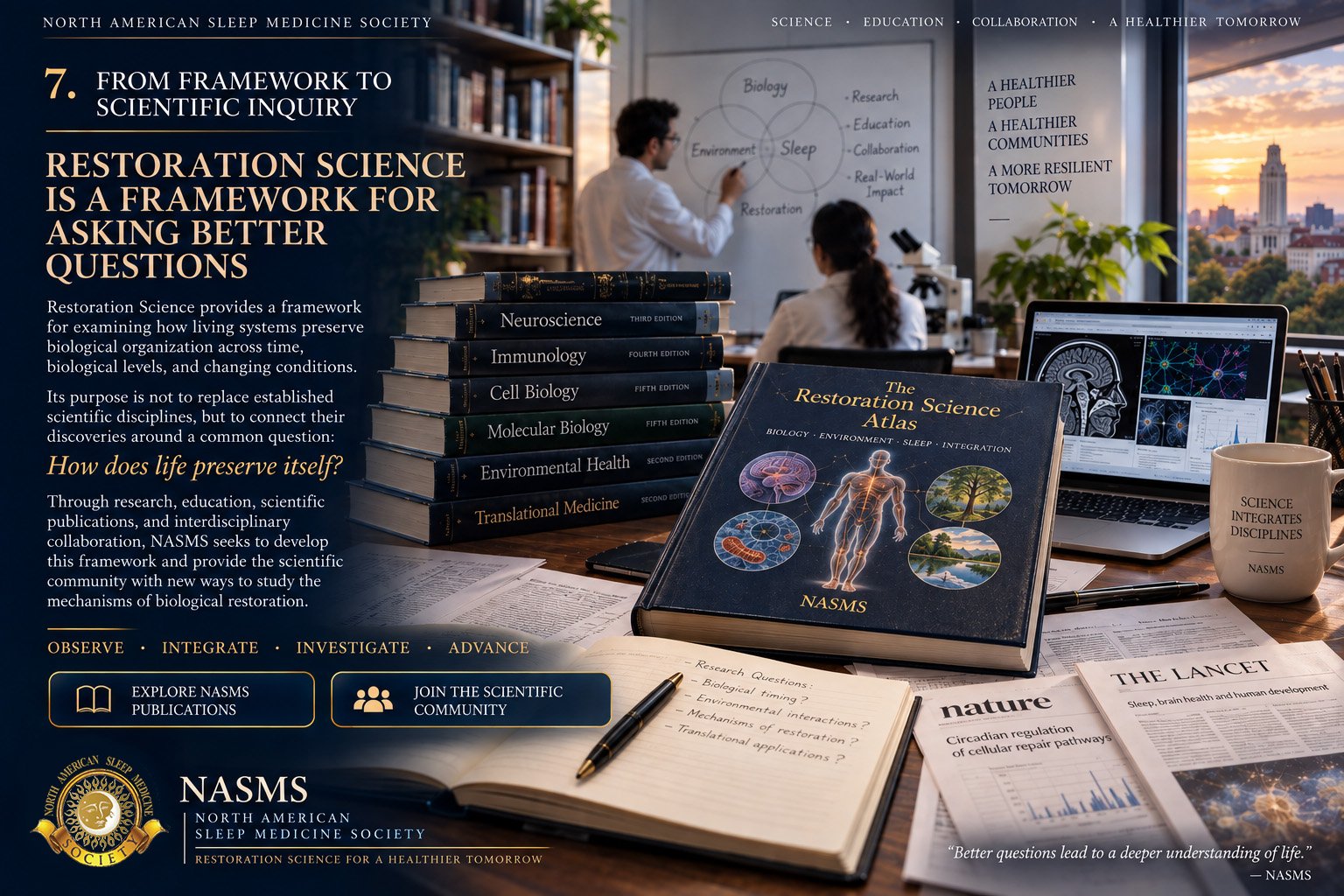
FROM FRAMEWORK TO SCIENTIFIC INQUIRY

RESTORATION SCIENCE IS A FRAMEWORK FOR ASKING BETTER QUESTIONS

Restoration Science provides a framework for examining how living systems preserve biological organization across time, biological levels, and changing conditions.

Its purpose is not to replace established scientific disciplines, but to connect their discoveries around a common question: How does life preserve itself?

Through research, education, scientific publications, and interdisciplinary collaboration, NASMS seeks to develop this framework and provide the scientific community with new ways to study the mechanisms of biological restoration.
OBSERVE · INTEGRATE · INVESTIGATE · ADVANCE
Restoration Science framework connecting biological research, sleep, environment, education, scientific publications, and interdisciplinary inquiry.

TOGETHER FOR A MORE RESTORATIVE TOMORROW

NASMS is a scientific society dedicated to advancing knowledge, education, and collaboration in the science of human restoration.
North American Sleep Medicine Society (NASMS) seal

North American Sleep Medicine Society

Science in Service of Human Restoration

ABOUT

About NASMS

Mission & Vision

Governance

Leadership

Bylaws & Constitution

ENGAGE

Education

Events

Membership

Support NASMS

North American Sleep Medicine Society

PO Box 23007

Leander, TX. 78641

Email: info@nasms.org

Bluesky