North American Sleep Medicine Society (NASMS)
Austin, Texas, United States
PUBLICATION TYPE
SERIES
PUBLICATION ID
PUBLICATION YEAR
EDITION
PUBLISHER
LANGUAGE
Foundational Monograph
NASMS Foundational Monographs
NASMS-FM-001
2026
Founder’s Edition · First Edition
North American Sleep Medicine Society
English
ISBN Hardcover
ISBN Paperback
ISBN EPUB
ISBN PDF
DOI
LCCN
North American Sleep Medicine Society (NASMS)
Austin, Texas, United States
PUBLICATION TYPE
Foundational Monograph
SERIES
NASMS Foundational Monographs
PUBLICATION ID
NASMS-FM-001
PUBLICATION YEAR
2026
EDITION
Founder’s Edition · First Edition
PUBLISHER
North American Sleep Medicine Society
LANGUAGE
English
ISBN HARDCOVER
979-8-953537-00-1
ISBN PAPERBACK
979-8-953537-01-8
ISBN EPUB
979-8-953537-02-5
ISBN PDF
979-8-953537-03-2
LCCN
2026927599
Abstract
Modern medicine has developed an extraordinary understanding of the molecular, cellular, and physiological mechanisms involved in human health and disease. DNA repair, protein turnover, mitochondrial quality control, immune regulation, and cellular renewal have been investigated extensively. Yet understanding these mechanisms individually does not fully explain how their activities are organized within a living organism that must continuously maintain its biological integrity while responding to changing physiological demands.
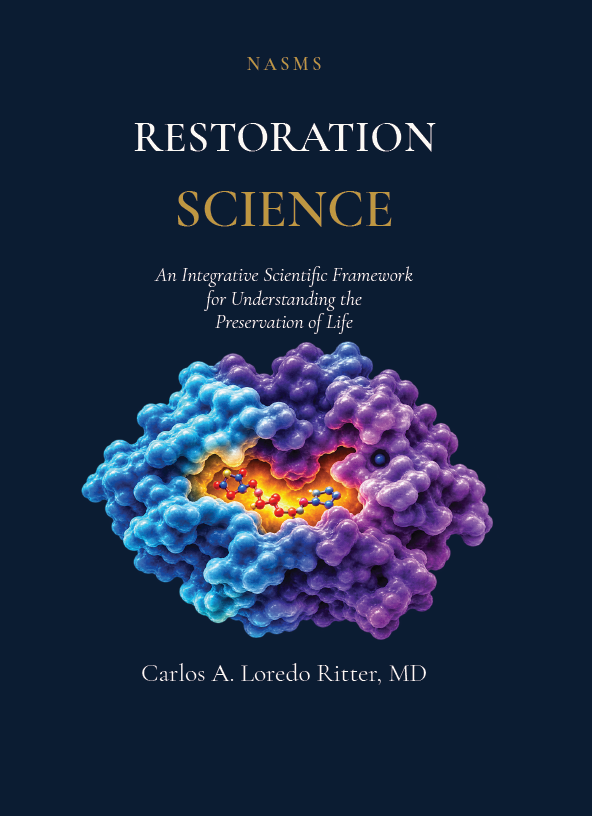
Restoration Science introduces an integrative scientific framework for examining this problem. Its central premise is that understanding disease and its treatment must be accompanied by a systematic investigation of the mechanisms through which living organisms preserve, repair, renew, regulate, and restore their biological structures and functions. The framework does not propose that these mechanisms are newly discovered. Rather, it directs attention toward their relationships, the resources required for their operation, and the regulatory processes through which biological preservation occurs across different levels of organization.
A central question concerns coordination: how do restorative mechanisms operating within individual cells, tissues, and organs contribute collectively to the preservation of the organism? The monograph examines this question across biological time, with particular attention to sleep as a recurring physiological state in which neuronal activity and its underlying electrical organization undergo characteristic changes. These changes provide an opportunity to investigate the relationships between neural regulation, endocrine signaling, and the molecular processes of maintenance, repair, and renewal occurring within individual cells throughout the organism.
The framework also examines the laws of physics governing biological function and the interactions between living organisms and their environments. It introduces Restoration Capacity as a conceptual approach to investigating the dynamic ability of an organism to maintain or recover biological integrity under ordinary physiological demands and environmental challenges.
For clinical medicine, the relevance of this investigation lies in connecting knowledge of individual biological mechanisms with the physiological complexity encountered in patients whose conditions involve multiple interacting systems. For scientific research, it provides a common framework for developing questions that require contributions from molecular biology, neuroscience, physiology, medicine, physics, and environmental science.
Restoration Science is presented as a foundation for investigation rather than a completed explanation of biological preservation. Its purpose is to identify relationships that warrant further examination, encourage testable hypotheses, and support interdisciplinary research capable of distinguishing established mechanisms from proposed relationships that remain to be demonstrated.
HARDCOVER
Founder’s Edition
PAPERBACK
First Edition
DIGITAL EDITION
eBook
DIGITAL EDITION
PDF